The Power Bill Is the Contract: Hosting Versus a Home Setup
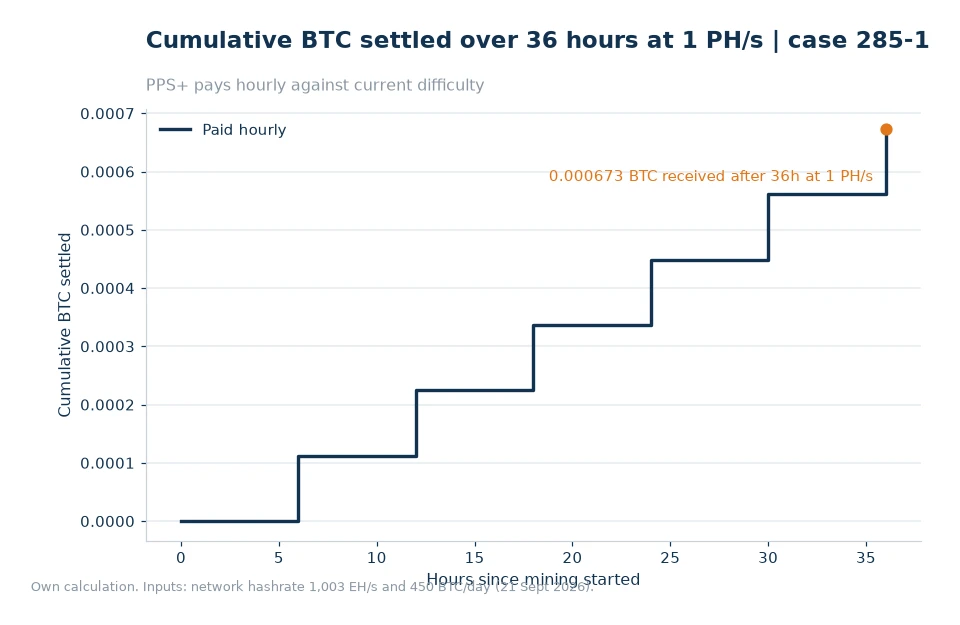
A mining rig produces the same coin wherever it stands, but the meter beneath it decides who keeps the margin. At 1 PH/s and 20 J/TH, thirty-six hours of hashing earns 0.00067291 BTC, about $56.99 at $84,692, while the machine pulls 720 kWh. At $0.06 per kWh that electricity costs $43.20, which leaves $13.79 before anything else is paid.

Key takeaways
- At 1 PH/s a machine at 20 J/TH draws 20 kW, or 480 kWh a day, which is 720 kWh across 36 hours.
- The same 36 hours credits 0.00067291 BTC, worth $56.99 at the 21 Sept 2026 price.
- Power at $0.06 per kWh accounts for $43.20 of that, leaving $13.79 for hardware, cooling and everything else.
- A hosted rate bundles space, cooling and hands into one figure, so compare it with the all-in cost of a home room rather than with the tariff alone.
Two invoices, one output
Every mining operation pays two kinds of bill. The first is the coin side, which is arithmetic on hashrate and difficulty and does not care where the hardware sits. The second is the facility side: electricity, cooling, space, repairs and the labour to keep it all running. Pool choice affects the first. Almost everything else on this page affects the second.
The mistake that costs the most is treating a cheap tariff as a cheap operation. A garage with domestic power may look attractive until the extra load pushes the property into a higher band, or until summer arrives and the room needs an air conditioner that was never in the budget. A hosted rate looks expensive until it is set against the same list of items, including the ones a home miner supplies with their own evenings.
It helps to write both bundles as monthly totals rather than as rates. A home setup is a tariff, a cooling appliance, a network line and a maintenance habit. A hosted setup is a single invoice, and what it buys is predictability: the same figure every month whether the machine runs well or badly. Predictability is a real product, and the only way to price it is to know what the alternative costs.
What a kilowatt-hour buys at 1 PH/s
One petahash is a useful reference size because the power draw is easy to hold in your head. At 20 joules per terahash, 1,000 TH/s consumes 20 kilowatts. Run that for an hour and the meter advances 20 kWh. The pool meanwhile credits 0.00001869 BTC, which at $84,692 is $1.58. The comparison between $1.58 and the local price of 20 kWh is the entire margin argument in one line.
Nothing about that comparison is fixed. Older machines run at 30 J/TH or worse and consume half again as much for the same hashrate, which is why a second-hand unit at a low purchase price can cost more over a year than a newer one. The efficiency figure belongs next to the price on every quotation, not in a footnote.
Cooling adds a second draw that the nameplate does not mention. Fans inside the machine are already counted in the J/TH figure, but an air conditioner or an extraction fan in the room is not, and in a warm climate that equipment can add a quarter to the total load. Budget it as part of the facility, because the pool has no way to know about it.
Thirty-six hours of credits
The rows below pair the coin side with the meter. Power is priced at $0.06 per kWh, a round figure chosen to make the arithmetic visible rather than to describe any particular region.
| Elapsed | BTC credited | Gross value | Electricity cost | Before other costs |
|---|---|---|---|---|
| 6 h | 0.00011215 | $9.50 | $7.20 | $2.30 |
| 18 h | 0.00033645 | $28.50 | $21.60 | $6.90 |
| 30 h | 0.00056076 | $47.49 | $36.00 | $11.49 |
| 36 h | 0.00067291 | $56.99 | $43.20 | $13.79 |
The final column is not profit. It is what remains before the purchase price of the machine, the network connection, the fans, the repairs and any hosting fee are counted. Its value is comparative: run the same table at your own tariff and the difference between two locations becomes a number rather than an opinion.
Worked example
Both sides of the table come from short divisions, so the result can be rebuilt from first principles.
- Daily coin at 1 PH/s: 1,000 × 0.00000044865 = 0.00044861 BTC.
- Thirty-six hours: 0.00044861 × 1.5 = 0.00067291 BTC.
- Dollar value: 0.00067291 × 84,692 = $56.99.
- Power draw at 20 J/TH: 1,000,000 GH/s × 20 J = 20,000 W, or 20 kW.
- Energy over 36 hours: 20 kW × 36 h = 720 kWh.
- Cost at $0.06: 720 × 0.06 = $43.20.
- Difference: 56.99 − 43.20 = $13.79 for the window.
Reading a facilities quote line by line
A hosting quote usually arrives as one rate per kilowatt-hour, with the interesting parts elsewhere. Ask what the rate includes: cooling, network, monitoring, physical space, and the labour to swap a failed board. Then ask what it excludes. A low headline rate with repair billed at an hourly call-out can end up dearer than a higher rate that covers the work.
ViaBTC Mining Farms lists hosting options for miners who want the facility side handled, and the Miner Hosting section gathers operators who host hardware they do not own. Both are starting points for a shortlist. Neither replaces a written contract, and neither turns a tariff into a guarantee.
Heat, noise and costs outside the meter
A home operation pays in ways that never appear on an electricity bill. The room gets hot, the fans get loud, and the household notices both. Ducting heat outside in summer is cheap to describe and awkward to install. Insurance may need to know about the load. A fault at two in the morning is yours to fix, and a spare part is yours to keep on a shelf.
None of that makes home mining a bad choice. It makes it a different bundle. The honest comparison puts a price on the homeowner's time, on the spare parts, and on the cooling kit, then adds those to the tariff. Once they are on the same line, the hosted rate stops looking like an expense and starts looking like a quote for work you would otherwise do yourself.
Uptime belongs in that bundle too, and it is the item most often left out. A home machine that stops on a Friday may sit idle until Sunday evening. A facility with staff on site can swap a power supply the same day. At 1 PH/s each idle hour forgoes 0.00001869 BTC, which sounds trivial until a whole weekend disappears from the month.
Frequently asked questions
How much electricity does 1 PH/s use in a day?
At 20 J/TH it draws 20 kW, so a full day consumes 480 kWh. Across 36 hours the meter advances 720 kWh, which costs $43.20 at $0.06 per kWh.
Does a hosting fee replace the electricity bill?
Usually it bundles power with space, cooling and labour, but the split varies by provider. Ask which items are inside the rate and which are billed separately before comparing two quotes.
Is a lower tariff always the cheaper option?
No. A low tariff with repair call-outs, poor uptime or extra cooling charges can cost more than a higher all-in rate. Compare the full daily cost against the 0.00044861 BTC that 1 PH/s produces in a day.
Compare the totals after the meter
Take your own tariff, multiply it by the 720 kWh a 1 PH/s machine uses in 36 hours, and set the result against $56.99. Do the same with a hosting quote. The gap between the two is the price of convenience, and it is either worth paying or it is not; what it should never be is unknown. The Profit Calculator handles the coin side so the comparison stays on the facility side, where the decision actually lives.
Sources: farms, companies and calculator pages on viabtc.com, plus the 4% rate listed against the block-reward stream[1]. Data read 21 Sept 2026: network 1,003 EH/s, subsidy 3.125 BTC, 144 blocks daily, BTC $84,692. Published 24 Oct 2026; power figures assume 20 J/TH around the clock.