How a Home Fragrance Product Gets Costed, Step by Step
A home fragrance unit cost is built in a fixed sequence, and the order matters more than the arithmetic. The application category sets the dosage ceiling, the dosage sets the oil cost, the oil sets the substrate and the delivery system, and only then can the vessel, closure and carton be priced. Teams that start with the vessel get a number that changes every time the scent brief moves.
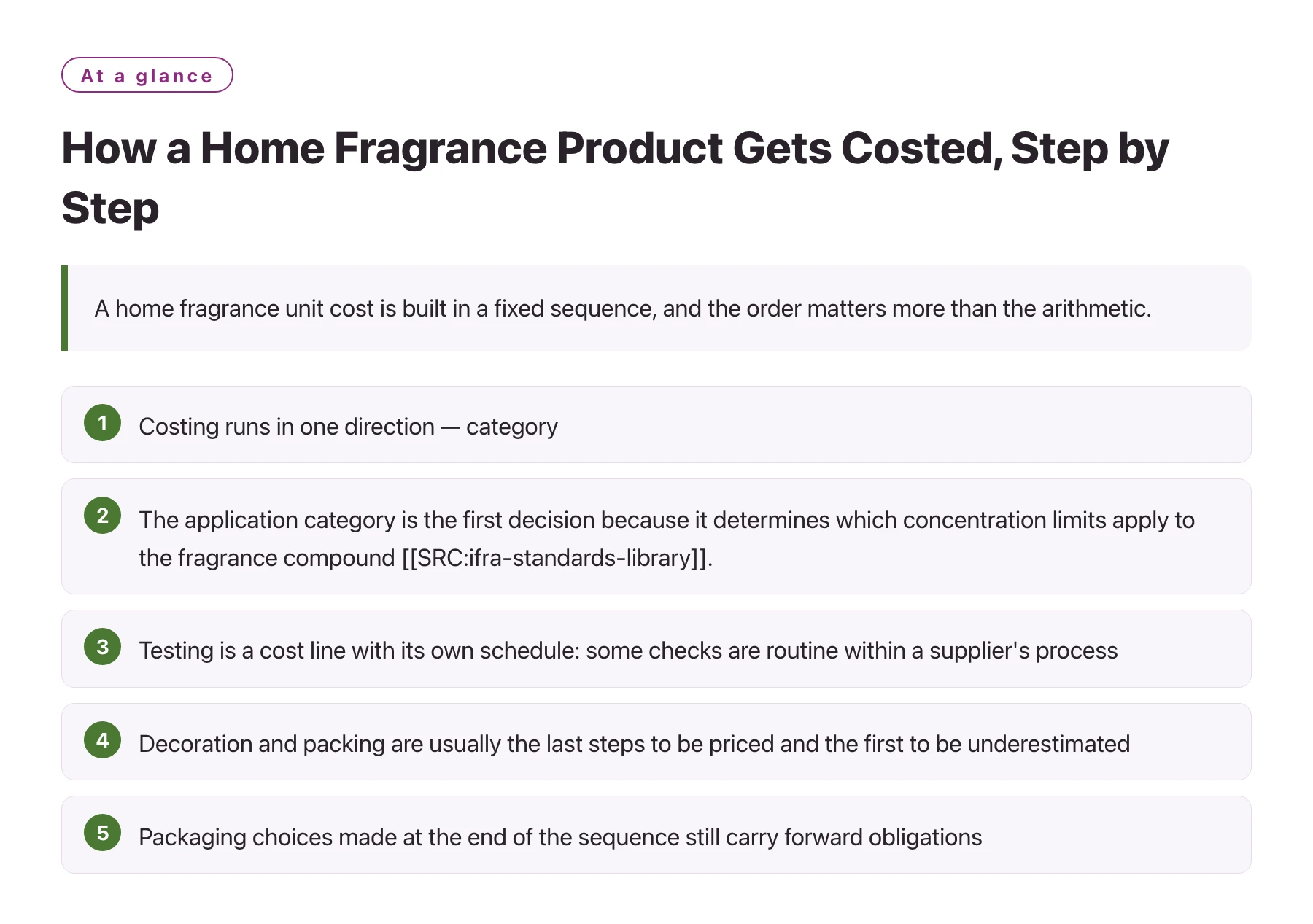
Key takeaways
- Costing runs in one direction — category, dosage, substrate, delivery, vessel, packing, decoration — and reversing the order produces quotes that keep changing.
- The application category is the first decision because it determines which concentration limits apply to the fragrance compound [1].
- Testing is a cost line with its own schedule: some checks are routine within a supplier's process, while others are commissioned and add both cost and calendar time [2].
- Decoration and packing are usually the last steps to be priced and the first to be underestimated, because both carry setup costs that repeat with every new size.
- Packaging choices made at the end of the sequence still carry forward obligations, including the material and reporting requirements that apply to what is placed on the market [3].
Ask two suppliers for a home fragrance price and you will usually get two numbers that cannot be compared, because each has quietly assumed a different fill volume, substrate or carton. The way to make quotes comparable is to walk the same sequence with both, and to stop at each step until it is frozen.
This is the order that works, with the point at which each step becomes expensive to reverse.
The costing sequence
- Fix the application categoryCandle, reed diffuser, room spray, linen mist, car product. The category determines the concentration limits the fragrance compound has to satisfy, so it is the first thing to write down rather than the last.
- Set the dosage and intensity targetDosage is expressed as a percentage of the finished product and is the main driver of the oil cost. Fix a target intensity at the same time, because intensity and dosage are different things and conflating them is how a line ends up both expensive and weak.
- Choose the substrateWax type, carrier solvent or aqueous base. Each has a different tolerance for the oil and a different evaporation or burn profile, and each changes the fill process.
- Specify the delivery systemWick type and size, wickless reeds, spray pump or crimp. This step decides whether the assembly works, and it is verified by testing rather than by sampling on a blotter.
- Freeze fill volume and closureFill weight with a tolerance, headspace, neck finish and closure. Once the glass is ordered these are effectively locked, so they must be settled before any packaging deposit.
- Price the vessel, closure, carton and decorationNow the packaging can be quoted against a specification rather than a guess. Setup costs, minimums and decoration steps enter the model here and repeat for every additional size.
- Add handling, testing, packing and freightThe residual lines that decide the difference between a viable price and a fragile one: line changeover, inspection, document preparation and inland freight to the port.
Where each step becomes expensive to reverse
| Step | Reversible until | Cost of changing later | Evidence to keep |
|---|---|---|---|
| Application category | Any time before the oil is chosen | Reformulation against a different limit set | Written category on the brief |
| Dosage and intensity | Before the first bulk blend | New oil load, new cost model, new approval | Approved dosage on the specification sheet |
| Substrate | Before the performance test | Re-testing burn or evaporation on a new base | Test record on the production substrate |
| Delivery system | Before tooling or component order | Component minimums bought and unusable | Component drawings and supplier reference |
| Fill volume and closure | Before the glass order | Obsolete vessels, cartons and labels | Fill weight and tolerance in writing |
| Decoration and packing | Before the print deposit | Setup paid twice, artwork re-separated | Approved artwork and dieline revision |
The table is a schedule as much as a costing tool: each row names the moment after which a change costs real money, and those moments are the natural approval gates in a development project.
Two lines that buyers consistently miss
The first is testing. Some checks live inside a manufacturer's normal process and appear as nothing on the quote; others are commissioned from an external laboratory and add both fee and waiting time. IFRA sets the framework that concentration limits sit inside, and the compliance of a specific compound is assessed against it [1], while the actual laboratory work — stability, compatibility, safety-related testing — depends on what the destination market asks for and on what the testing provider is equipped to run [2]. Asking which tests are routine and which are billed turns an uncertain line into a fixed one.
The second is packaging obligations. Material choices made at step six are not purely aesthetic; they carry obligations about what can be placed on the market and what has to be reported. Sustainable packaging guidance from industry groups is a useful way to anticipate those requirements before the vessel is ordered rather than after [3]. A carton that is cheap today can be the reason for a redesign in a year.
The margin model should follow the sequence, not precede it
Teams sometimes start from a target retail price and work backwards to an allowable unit cost. That is a legitimate business constraint, but it should be applied as a filter after each step, not as the basis of the first quote. Working backwards from retail tends to produce specifications that exist only on a spreadsheet, and suppliers will price the specification they are actually given.
Where a factory's own scope changes the arithmetic
A partner that handles both fine fragrance and home fragrance, such as Xuelei fragrance manufacturer, can usually run several of these steps in house, which removes a tier of handling and freight between them. Whether that is cheaper depends on the specification; what it always changes is the number of parties who can cause a delay.
Turning the sequence into a comparison
Once a brand has walked these steps with one supplier, it can send the same frozen sequence to a second and get a genuinely comparable price. The brief should state the category, dosage, substrate, delivery system, fill volume with tolerance, decoration method and volume tier. Suppliers who work this way will recognise the format immediately, and their answers will differ where it is meaningful rather than where it is accidental.
If the product is being developed from a brief rather than transferred as a full specification, the earlier steps become a development scope rather than a costing exercise. bespoke fragrance development and production covers how a factory structures that work, which is worth reading before the second round of quotes so the two documents line up.
Keep the sequence visible to the whole team
The most common internal failure is a design decision that arrives after the costing has been agreed. Holding the sequence in one shared document, with the freeze point marked on each row, gives sales, product and finance the same view of what is still open.
Sources
- IFRA Standards Library (International Fragrance Association) —— The IFRA Standards Library lists the restrictions the fragrance industry applies to individual fragrance ingredients, based on safety assessments; it is the reference point for compliant fragrance formulation.
- SGS: Cosmetics, Personal Care & Household Testing —— Testing, inspection and certification services for cosmetics and personal care, including microbiological, stability and safety testing aligned with cosmetics GMP.
- Sustainable Packaging Coalition —— A membership organisation working on more sustainable packaging design, publishing material and recyclability guidance.
Frequently asked questions
What drives home fragrance unit cost most?
Usually three things in combination: the oil dosage, the vessel and the decoration or packing step. Each is decided at a different point in the sequence, which is why costing has to be revisited when any of them moves.
Should testing be in the quotation or billed separately?
Either is workable as long as the split is explicit. Ask which tests are part of the normal process, which are commissioned externally, and what each costs, then put the answer in the costing sheet rather than in an email thread.
How early can a supplier give a firm unit price?
A firm price needs a frozen specification: category, dosage, substrate, delivery system, fill volume, closure, decoration and packaging, plus a volume tier. Before that point any number is an estimate, however confidently it is presented.
Does an extra pack size really change the cost model?
Yes, because it usually changes the vessel and the carton, not just the fill. Sizes created by scaling the liquid alone often end up with packaging that is oversized or underfilled relative to its cost.
What is the cheapest step to change if the price is too high?
Decoration is usually the most flexible, followed by the carton structure and the closure. Dosage can be reduced, but only within the limits that apply to the category and without breaking the intensity target the brand promised.